
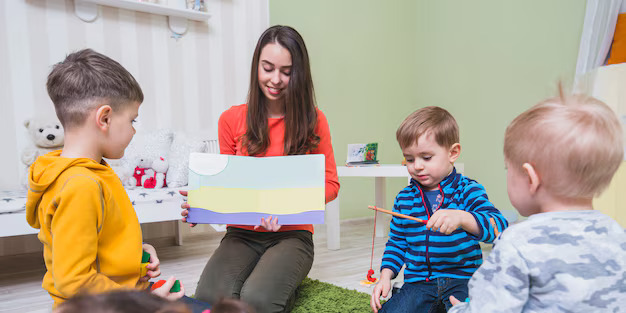

Early Childhood Care and Education (ECCE) represents a crucial period in a child's developmental journey, setting the stage for their future academic success and personal growth. During these formative years, children develop essential cognitive, social, and emotional skills that serve as building blocks for lifelong learning. At the heart of effective ECCE lies one of the most powerful educational tools: play-based learning.
Play-based learning in preschool education isn't just about letting children have fun – it's a sophisticated pedagogical approach that aligns perfectly with how young minds naturally develop and learn. When children engage in purposeful play, they're actually participating in complex learning processes that enhance multiple developmental domains simultaneously.
Through play, children develop critical thinking skills as they solve problems in their pretend scenarios, like figuring out how to build a stable block tower or negotiating roles in dramatic play. Social skills flourish as they learn to share, take turns, and collaborate with peers. Language development accelerates as they engage in conversations, tell stories, and express their ideas during play activities.
The beauty of play-based learning lies in its organic nature. When children are genuinely interested and engaged in their play, they're more likely to retain information and develop positive associations with learning. Whether they're counting toys, sorting colors, or creating patterns with beads, they're developing mathematical concepts without the pressure of formal instruction.
Educators play a vital role in this process by creating enriching environments that encourage exploration and discovery. They thoughtfully integrate learning objectives into play activities, observe children's interests, and extend their learning through gentle guidance and open-ended questions.
As we continue to understand the science behind early childhood development, the significance of play-based learning becomes increasingly evident. It's not just about preparing children for school – it's about nurturing curious, confident, and capable learners who are ready to embrace the challenges and opportunities that lie ahead in their educational journey.
Innovative Teaching Methods for Preschool Classrooms
Today's preschool education is undergoing an exciting transformation with innovative teaching approaches that blend traditional wisdom with modern methodologies. Teachers are creating dynamic learning environments that incorporate project-based learning, where children explore concepts through hands-on projects like creating miniature towns or running pretend restaurants. Technology is thoughtfully integrated through interactive smartboards and simple coding toys, enhancing rather than replacing traditional play. Sensory-rich environments featuring light tables, texture walls, and outdoor learning spaces provide immersive experiences that support holistic development. STEAM concepts are introduced naturally through play, while mindfulness practices help children develop emotional intelligence and self-regulation skills. Flexible learning spaces accommodate different learning styles, and digital documentation tools help track progress and share insights with parents. These methods all share a common goal: respecting children's natural curiosity while providing meaningful experiences that support their development. The success lies not in implementing every new trend, but in selecting approaches that best serve each unique group of children while maintaining essential developmental principles.
Step-by-Step Guide to Designing a Thematic Preschool Curriculum
Creating an effective thematic preschool curriculum requires careful planning and a deep understanding of early childhood development. The process begins with selecting age-appropriate themes that spark children's curiosity and connect to their daily experiences, such as "Weather and Seasons," "Community Helpers," or "Ocean Life." Each theme should span 2-4 weeks, allowing sufficient time for deep exploration while maintaining engagement. The curriculum design should integrate all developmental domains—cognitive, social-emotional, physical, and language – through varied activities like storytelling, art projects, science experiments, and dramatic play. Learning centres must be thoughtfully arranged to reflect the current theme, with materials that encourage independent exploration and collaborative learning. Daily schedules should balance structured activities with free play, incorporating both indoor and outdoor experiences. Assessment methods must be built into the curriculum through observation checklists and portfolio collections, helping track children's progress and adjust teaching strategies accordingly. The key to success lies in maintaining flexibility within the structured framework, allowing teachers to follow children's interests while ensuring essential learning objectives are met. Regular parent communication about themed activities helps extend learning beyond the classroom, creating a comprehensive educational experience that supports each child's development